
Global Energy Cycle
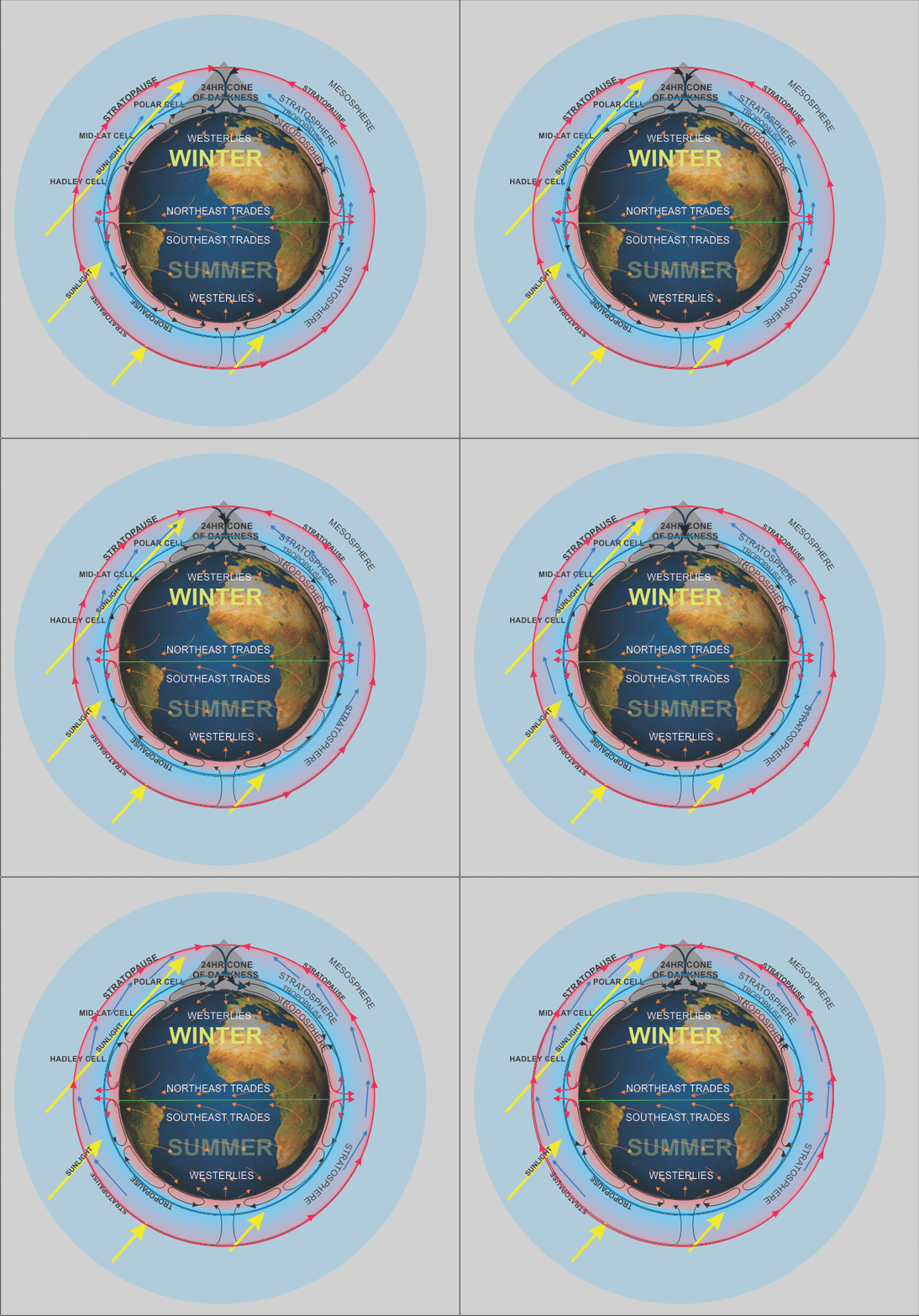
The Global Energy Cycle is almost entirely driven by solar energy as the daily and seasonal changes in temperature generate thermals that are closely related to local and regional changes in Relative humidity (Rh) and atmospheric pressure. These reactions are complex to start with but are further complicated by at least two additional basic physical facts.
- Nominally "wet" and "dry" air columns cool at very different rates as they rise or fall through the surrounding atmosphere, with the so-called "Lapse" rate for "dry" air being 50% greater than for nominally "wet" air. (DALR=10oC/km; WALR=~6.5oC/km).
- Nominally "wet" air, (ie containing water vapour), can potentially be at least twice as buoyant as dry air, until such times as it cools to the dew point and the water condenses out.
What is particularly relevant here, is that a dry thermal can reach to extreme altitudes without it triggering a storm but it will cool far faster (10oC/km) than a neighbouring thermal of "wet" air, or air containing water vapour. Being dry, a dry air thermal will be relatively stable and more-or-less ideal for carrying an aircraft safely to high altitude. Also, along with jet streams it's though such thermals may be responsible for so called 'clear air turbulence' which doesnt show up on radar.
As covered under the separate heading, of the pyramid technology, the characteristics of the wet air thermals can vary dramatically depending upon the vapour content and on whether the water vapour merely condenses out and then possibly freezes when it reaches the dew point, to creat hail, or whether the vapour is rising so fast and cools so rapidly, it doesn't condense out at all but "super-cools" and then flash-freezes directly into tiny ice crystals that are far lighter than the surrounding air.
This last process is most commonly seen high in the air above Tropical Depressions, where a newly-discovered phenonena known as a Hot Tower has entirely reshaped our understanding of the workings of our global atmosphere, from the previous model, shown here. to the new model, shown above
In Nature, the many variables make it impossible to predict exactly what will happen, or even when and where but by acting pre-emptively, many of these steps can be forestalled or eliminated, opening up some entirely predictable oportunities to effectively intevene in mitigating or even controlling completely the general outcome of some potentially catastrophic weather events, like major tornados and cyclones and even the seasonal winter extremes of a whole hemisphere.
When the sun releases energy into the surrounding atmosphere, as water-vapour, it raises the regional air pressure in a relatively steady process that generally peaks at midday, However the process of the water-vapour recondensing as the sun goes down can be extremely energetic, and can potentially trigger the positive feedback (PF), vortex mechanisms, of the many different Atmospheric Vortex Engines (AVEs) that we know as different types of storm.
Every storm type is different; with some lasting seconds and others last hours, days or even weeks. It mainly depends upon the orientation of the storm's main axis of rotation, with perfectly horizontal vortexes, over water, being in a class of their own as to power and longevity and those that are even slightly tilted, generally breaking up within minutes, often with extreme violence.
Basically, whilst the vortex remains horizontal, it can continue as a relatively-stable entity that can continuously absorb energy from the atmosphere and/or the surface of the open sea. A storm, like a cyclone or storm front, that draws its energy directly from the surface of the open ocean can last weeks. Without ever crossing land,1974 Pacific Cyclone "Tip" lasted a month and is said to have developed more power throughout this whole time than all the power stations on Earth combined.
However, once tilted or disrupted, even slightly, normally by crossing a coastline, even the largest storm will start breaking up and will then normally disperse within hours. Significantly, any vortex that doesn't start out horizontal, can only ever last for as long as it can draw directly upon an air mass containing moisture. It normally lasts only a few minutes and never more than an hour or two.
In a location like the central states of the USA, a large, natural "Energy Differential" commonly occurs on a regular seasonal basis, due to the conjuction, at altitude of two very different air masses, with a warm and wet air mass coming up from the south and and cold and very dry air coming down from Canada and the Rocky Mountains. Meeting at the famous "DryLine", the potential for extremely intense "Series" and "Supercell" tornados is entirely apparent. Also apparent, is the possibility of pre-emptively converting this deadly energy potential into hundreds of far less devastating, conventional storms instead of a far smaller number of tornados of either type.
Properly understand the basic mechanisms and logic would suggest that, by suitably engaging Chaos Theory’s ‘Butterfly Effect’, it should ultimately be possible to copy Nature and draw all the energy we need directly from the oceans and surrounding atmosphere.
The whole MACE research and developing technology is indeed based on replicating and exploiting various useful vortex combinations so as to ultimately control the weather and access all the power we could ever need by applying a far better understanding of Nature's many "Atmospheric" Vortex Engines (AVEs).
From a chance occurence 66 years ago, the author has developed the MACE technology from what is now a totally compelling library of evidence that suggests the Pharos Lighthouse at Alexandria and Great Pyramids at Giza, were built to an extremely high level of sophistication, still far beyond our present abilities, to effectively harness solar power on a local, regional and even a global basis, by fully exploiting the various vortex combinations of our planet's Global Energy Cycle
Moving From Theory to Practice
However, in exploring how best to utilise the special attributes of storms, tornados and cyclones, it soon became apparent I was merely following in the footsteps of the engineers of Ancient Egypt who had built the Great Pyramids at Giza and the Pharos Lighthouse at Alexandria.
Despite following the trail of evidence for a great many years, it’s only very recently that the full potential of this Ancient technology, to solve ALL the problems associated with Global Warming, has become fully apparent and potentially provable.
Reconstructing the Broader Perspective
Numerous different energy units, each with its own unique role, create the massively complex and fully-automatic Solar-powered ‘Atmospheric’ Vortex Engine, we know as the Global Energy Cycle (GEC).
To appreciate how all the many diverse elements contribute to a ‘whole’ that automatically maintains the balance of Nature, we must first understand how each unit works, and how to potentially "tweak" it.
- From the evidence and tests conducted so far, it seems highly likely that the keys to a far brighter future may well lie in the technology now-largely recovered from the Pharos Lighthouse and the 50,000+ pyramids of all types, from large to very small and found right around the world.
- Included, is the specific role played in major weather events by the ‘normal’ and ‘Inverted’ horizontal Ring Vortexes (NRVs and IRVs) whose significance has, until now, has gone largely unrecognised.
- However, the final and decisive key was the discovery, in 2019, that tiny ice crystals, fed into the Stratosphere by Hot Towers, ultimately create a positive feedback mechanism (PFM) that links Pacific cyclones with the Polar Vortex and the recent extreme winters of the Northern hemisphere.
It remains to be proven but when these three elements are viewed from the just the right perspective, it reveals a possibility that’s so astonishingly complete and so perfectly precise, it just has to be true.
The MACE Hypothesis and the Balance of Nature
“Sometimes it’s the small things that count most”
It’s entirely accepted that over 99.99% of our weather is created as the ‘flash-condensation’ of water vapour in the Troposphere drives the many different types of storm we can all so readily identify.
Until recently the 0.01% of vapour remaining in the Stratosphere, was considered of so little importance, it’s not even shown on what is still the generally-accepted model of our working atmosphere.
Much like the CFC/ozone layer problem of the 80’s, it’s now known that the ‘presence-or-absence’ of minute traces of water ice at the top of the stratosphere play a highly critical role in controlling the winter weather, most especially in the Northern Hemisphere where the Arctic Ocean covers the pole
Based on the revised theoretical model of the GEC, as highlighted by NASA’s ATTREX program, the MACE Hypothesis explains just how and why tiny ice crystals, sublimating at the top of the Stratopause’s Inversion Layer, drive a critical PFM (‘positive feedback mechanism’) that controls the southern spread of extreme winter weather.
When it's present, vapour at the Stratopause drives the Polar Vortex more intensely, keeping the more extreme weather closer to the pole, but when absent, the Polar Vortex "fails" and winter storms spread much further south.
Ultimately Control is all about Positive Feedback
Drifting up over 60 days and absorbing solar energy, the ice crystals released into the stratosphere finally sublimate near the stratopause (line in red, at ~50km alt.), where temperatures have once again risen to ~ 0oC.
As the water vapour enters the 24hr cone-of-darkness above the winter pole, it recondenses, massively reducing in volume and setting up a PFM that supplies energy to the Polar Vortex. The stronger the vortex, the more it constrains the southerly spread of extreme winter weather.
As already mentioned, it's thought this critical mechanism (at 50km alt.) is highly analogous to that played by CFCs in the stratosphere at ~25km altitude and understanding how it ties in with the historical record and the Great pyramids, is potentially the key to solving all the problems of Climate Change; extreme weather, clean energy, fresh water, global transport and even, very probably, viable access to space.
The New Significance of the Polar Vortex
“Two steps forward, one step back”.
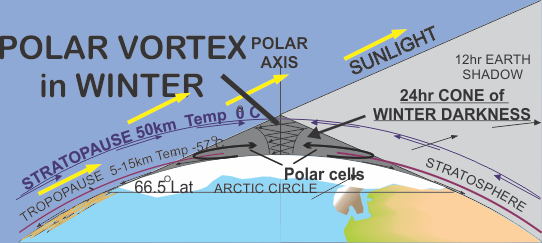
As a major component of both the GEC and the MACE engine, the Northern Polar Vortex has a number of unique features and from what little is known for certain about its role and operation, it so far appears to closely confirm the MACE Hypothesis.
Reaching high above the tropopause in mid-winter, the Polar Vortex operates where the air (@~0.3mb) is ~3000x thinner than at sea level, and the air’s water content, mostly in the form of ice crystals, is barely detectable, at below .01gm/m3.
Shown here as the true upper boundary of the working atmosphere, at around 50km at the winter solstice, it’s thought the 24hr winter cone-of-darkness, (as delineated by the tilt of the Earth’s axis) and the final sublimation of ice crystals is what physically determines the ultimate height of the Stratopause.
Despite the super-low vapour content and pressure, it’s thought the Polar vortex is still triggered in a manner similar to other atmospheric vortexes, ie by a sustained drop in temperature, (in this case triggered as water vapour passes into the 24hr cone of darkness high above the winter pole.)
Three main factors determine the severity of the winter weather in the Northern Hemisphere.
- The unchanging tilt of the Earth’s axis.
- The increasing presence of an ice-free Arctic Ocean below, and
- The level of water vapour at the Stratopause.
Recent changes in to the ice levels in the Artic Ocean have clearly reduced the E/D (energy-differential) needed to drive the critical PFM of the Polar Vortex, making the amount of vapour in the air even more critical. However, logic would still suggest that if the vapour content at the stratosphere could reliably be increased, it could significantly reduced the severity of the winter weather, which is exactly where the MACE research comes in.
Copy Nature, and you really can’t go wrong
Founded on Boyle’s Law and yet new to the Modern era, the MACE Hypothesis indicates potentially viable solutions to all the basic problems of so-called Global Warming.
Once triggered (@ ‘X’), Nature’s storms then operate entirely BELOW the Ambient Mean to produce ~1000x more ‘usable’ energy than all of Industry combined.
Logic suggested it must be possible to pre-emptively trigger these Natural events at will, but any true solution, ‘Solar’ or otherwise, has to work 24/7 all year round, viably producing clean ‘usable’ energy for every possible application.
The final missing piece in this puzzle, supplied by NASA’s ATTREX research, has shown how the presence-or-otherwise of tiny amounts of vapour at the stratopause can radically change the seasons. When aligned with all the previous evidence, especially from Giza, it confirms ‘Hot Towers’ (up next) as a major part of the global solution.
Inverted Ring Vortex (Cyclone's Eye)
The eye of a cyclone is the feature that most readily defines it as essentially the most powerful of all storms.
Roll Clouds (Storm Front)
Roll clouds are commonly formed along the leading edge of major frontal systems.
Thunderhead
As by far the most recognisable AVE, the thunderstorm is commonly triggered on warm, humid days, by naturally-occurring thermals.
Series Tornado
As by far the most intense AVE, the thin column of the "Series" tornado is very different from its larger cousin, the super cell storm. Although they are found quite close together, they are formed by quite different mechanisms.
essentially acts to energetically flash condense water-vapor into its two primary components, of fresh water and heat energy.
Supercell Tornado
As by far the most intense AVE, the tornado essentially acts to energetically flash condense water-vapor into its two primary components, of fresh water and heat energy.
Why Hot Towers are such Hot News?
A recent discovery by NASA’s ‘ATTREX’ program, into the workings of the Stratosphere has shed light on the workings of our whole atmosphere.
It is also, quite possibly, the most significant piece of evidence in solving any number of mysteries that span the whole 6500-year history of civilisation.