
The world’s oldest industrial building and 7th Wonder of the Ancient World
The 2nd major part of the Ancient Egyptian Technology that is the key to solving Global Warming
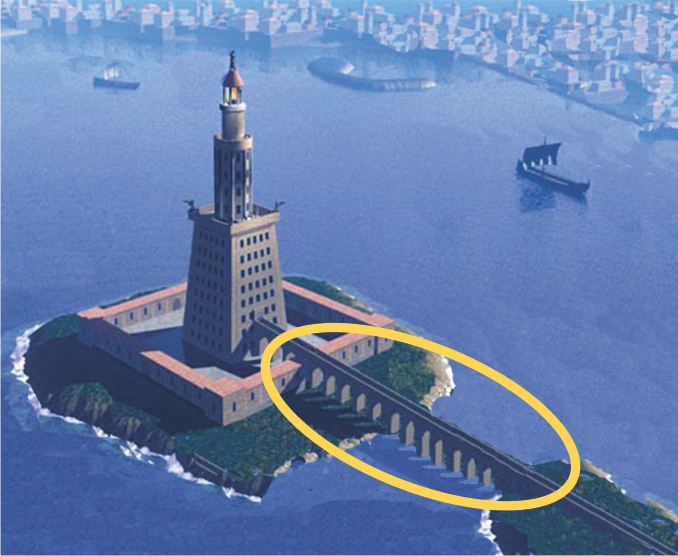
As a composite, built up from numerous available sources, this artistic reconstruction of the Pharos Lighthouse, (by researcher Lee Krystek, c2011 @www.unmuseum.org/pharos.htm ) provided the key insight towards potentially solving all the problems of Global Warming. The key feature of the drawing was the apparently-anomalous aqueduct, (circled below).
Built c300BC, the Pharos is known to have operated for over 1600 years and survived over 20 earthquakes before one finally destroyed it, c1310CE. That it was kept running for so long and underwent at least one and possibly two major structural renovations hundreds of years apart, is an obvious testament to the immense significance of its true role and purpose.
The only rational reason for such a massive building to have a viaduct and gently-sloping causeway leading away from it was that the viaduct was in fact an aqueduct and that somehow the building produced fresh water. All that remained was to work out exactly how it worked and then prove it.
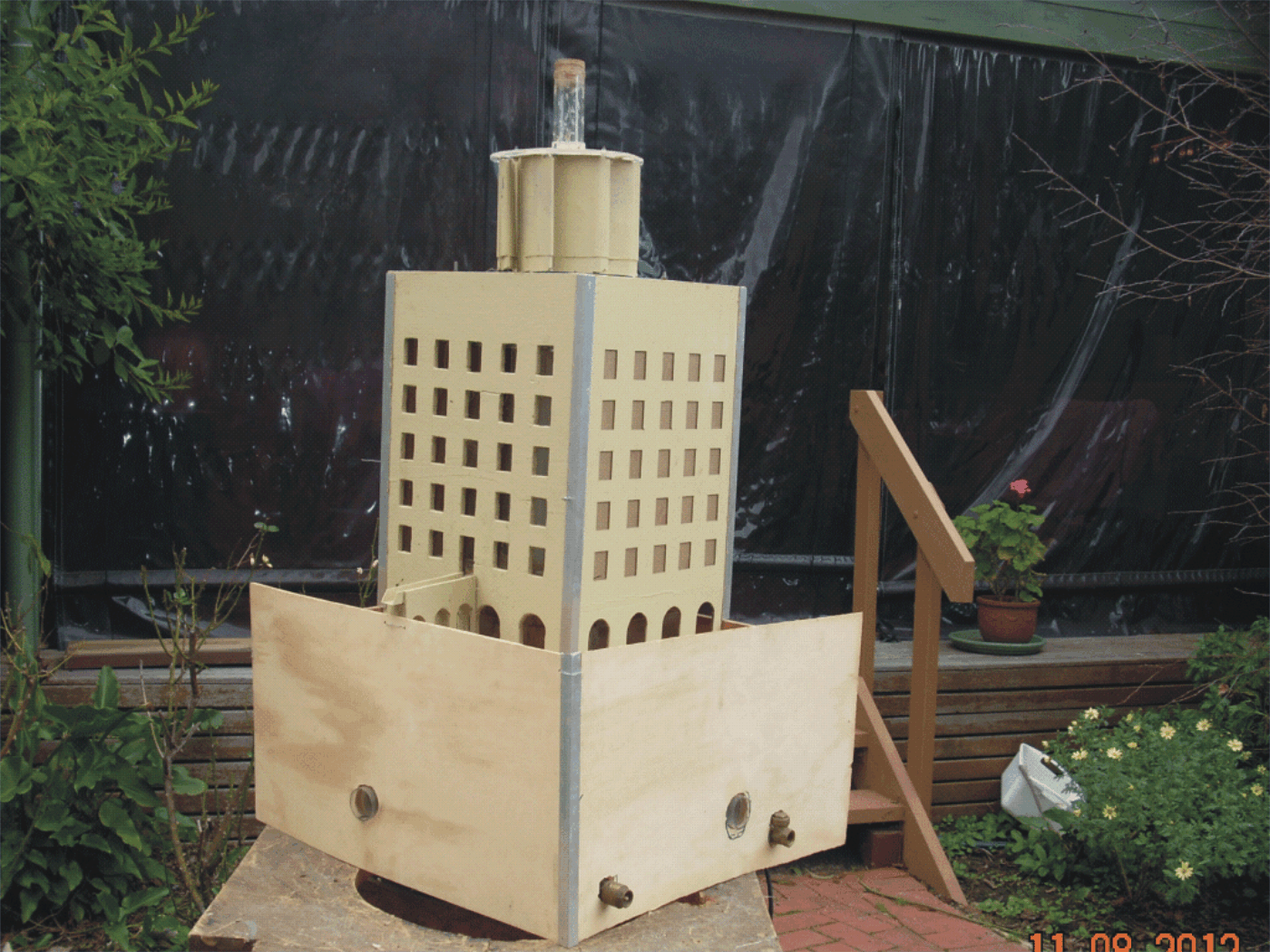
Author's 2012 proof-of-concept model
My Pharos study and the model reconstruction (see website www.how2harnesshurricanes.com/the-pharos-lighthouse) totally confirmed my earlier conclusion that the Pyramids and now the Pharos had served as highly sophisticated components within a largely-lost but clearly solar-based, energy technology of almost limitless power.
Back to Basic Principles
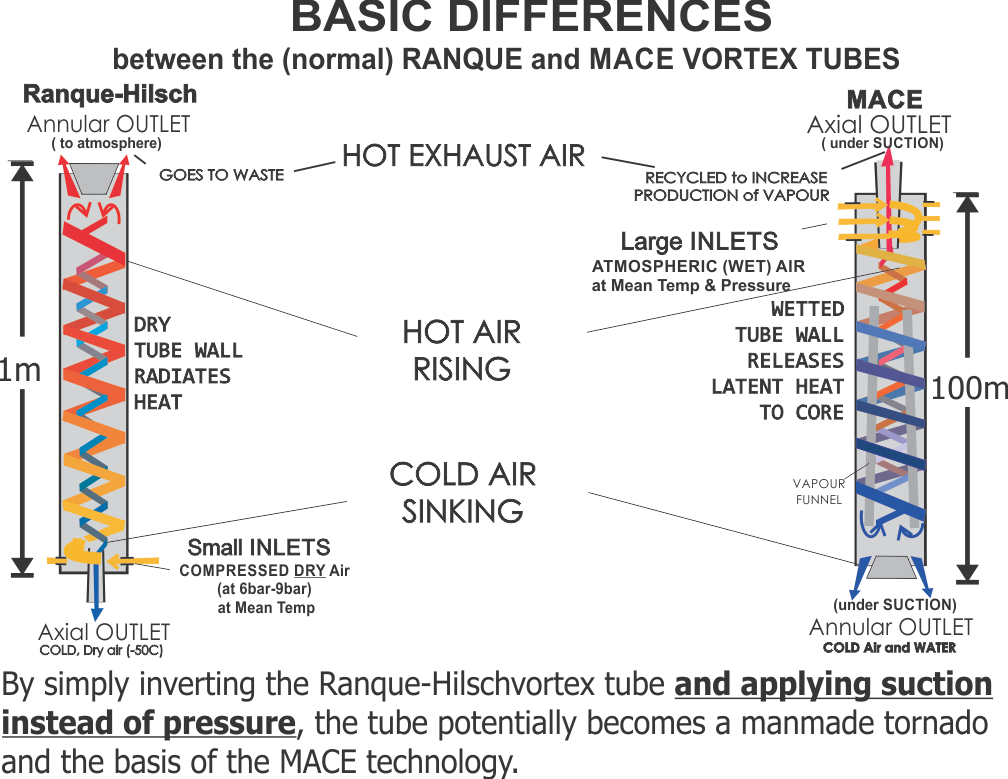
The basic principle of the Pharos' operation represents a major conceptual rework of one of the simplest mechanical devices ever invented, the Atmospheric Vortex Tube. What is not widely appreciate is that there are two types of vortex tube; one works on air pressure above the Ambient Norm, the other, on suction below it.
- The Ranque-Hilsch vortex tube, common in Industry, works above the Ambient Mean, on dry air supplied at high pressure (at ~6-9bar, 6000-9000mb, or 100-150psi). The Ranque tube commonly operates on an Energy Differential of ~5bar-8bar (or 5000mb-8000mb) ABOVE the Ambient Mean,
- The MACE vortex tube, mimicking Nature is driven essentially by suction, as water vapour flash condenses at pressures BELOW the Ambient Mean, of 1bar (1000mb. max).
Because Nature and the MACE operates on a maximum Energy Differential of ~300mb, (against Industries' 6000-9000mb) for obvious results, the MACE vortex tube must be significantly bigger than a comparable Ranque-Vortex Tube, as was evidenced by the vortex generator at the top of the Pharos tower being ~3m high and 3m-4m in diameter.
The one major advantage of the MACE vortex tube is that, once started, it can set up a positive feedback mechanism (PFM). This PFM can then feed, virtually without restriction, on any given volume of humid air, potentially stripping water vapour, as fuel, from an area quite possibly many kilometers in diameter.
The basic vortex tube has no moving parts but it does require either a constant supply of high pressure applied to its single inlet or a constant source of suction applied to both its hot and cold outlets. For the Ranque tube, the high-pressure source can only be produced artificially, by burning fuel. In Nature, and the MACE engine, the source is the water vapour in the atmosphere itself- which, having been stripped from the air by a vortex will within hours, replace itself entirely automatically by natural processes.
[When high-pressure air is injected tangentally at the junction of two tubes of different sizes, hot air will come out of one end and cold air out the other]
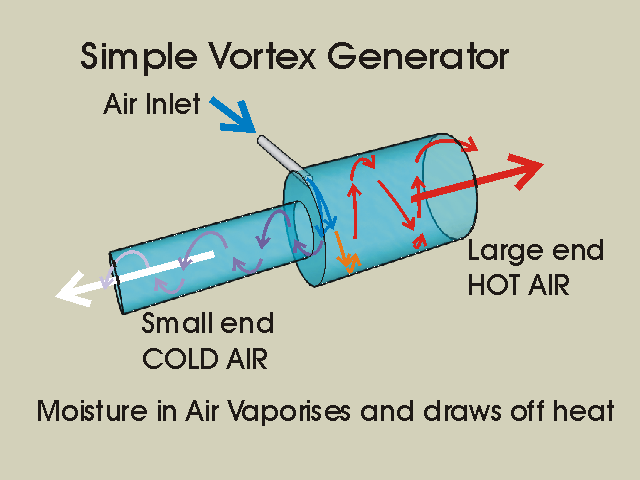
The Ranque Vortex tube is essentially a simple vortex generator driven by a source high-pressure air.
The MACE vortex tube
The MACE vortex tube also produces hot and cold air but it works on low pressure, not high, and whilst being one of the most significant mechanical device ever invented, the significance of its possible role and purpose was lost in the distant past and has not been in use since the collapse of the Pharos Lighthouse, c1300AD.
As can now be proven BARD, the Pharos Lighthouse employed a low pressure vortex tube to establish a manmade tornado within the tall, hollow lighthouse tower as a part of a much larger mechanism that controlled the operation of a fully controlled miniature, manmade cyclone operating in the air around the Pharos tower.
These images, clearly enineers drawings, supplied the detail that made the total reconstruction of the Pharos technology possible.
Just as in Nature, a man-made cyclone can extract fresh water, as water-vapour, from the surface of the totally-surrounding warm waters of the open sea. In the Pharos, the fresh water was then recovered from the air onto the cold surfaces of condensers, set out in rooms located on the 2nd, service corridor of the tower's double helix of corridors. The condensers were cooled internally by super-cooled brine produced within the tower's central, multi-stage vortex tube.
It is inherent in the Pharos technology that to establish a mini-cyclone, the start mechanism MUST be a vortex generator sited at the vertical centre of the proposed vortex donut or [NB. to produce a cyclone ~250m high, the vortex generator had to be 125m above the ground and totally surrounded by at least 500m open water.]
In the case of the Pharos, in order to drive the vortex generator (essential to the whole operation), suction had to be provided to both top and bottom of a vortex tube that, of necessity, had to be at the top of the tower and vertically-aligned, with the smaller outlet flue at the top heated by the beacon fire, to create a permanent updraft, exactly as occurs in any fireplace.
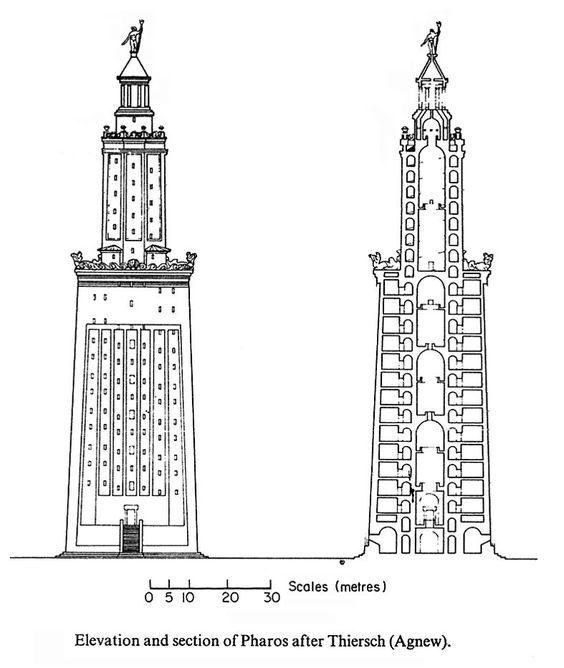
The downdraft was created by the weight of cold, humid air in the hollow stone tower. As the vortex was developed in stages down the tower from the vortex generator, so the falling cold air was induced, in 3 distinct stages, into the linear vortex rotation of a tornado. This rapidly established the man-made tornado, from the top, until it finally made "touchdown" somewhere near the base of the tower.
The phenomenon would have exactly replicated the formation of a "series" tornado, as commonly seen on the planes of the central states of America.
The whole vortex array was developed sequentially downwards from the vortex generator set at the top of the Pharos tower, just below the famous lighthouse beacon fire.
Imagine the vortex show here initially being produced on the ledge at the base of the top, round section of the tower. As the vortex its axis grew, it repeatedly flowed over the edge and dropped down to the next level
1st Stage
Above the top 17m round section of the tower, the famous beacon fire served three main purposes:
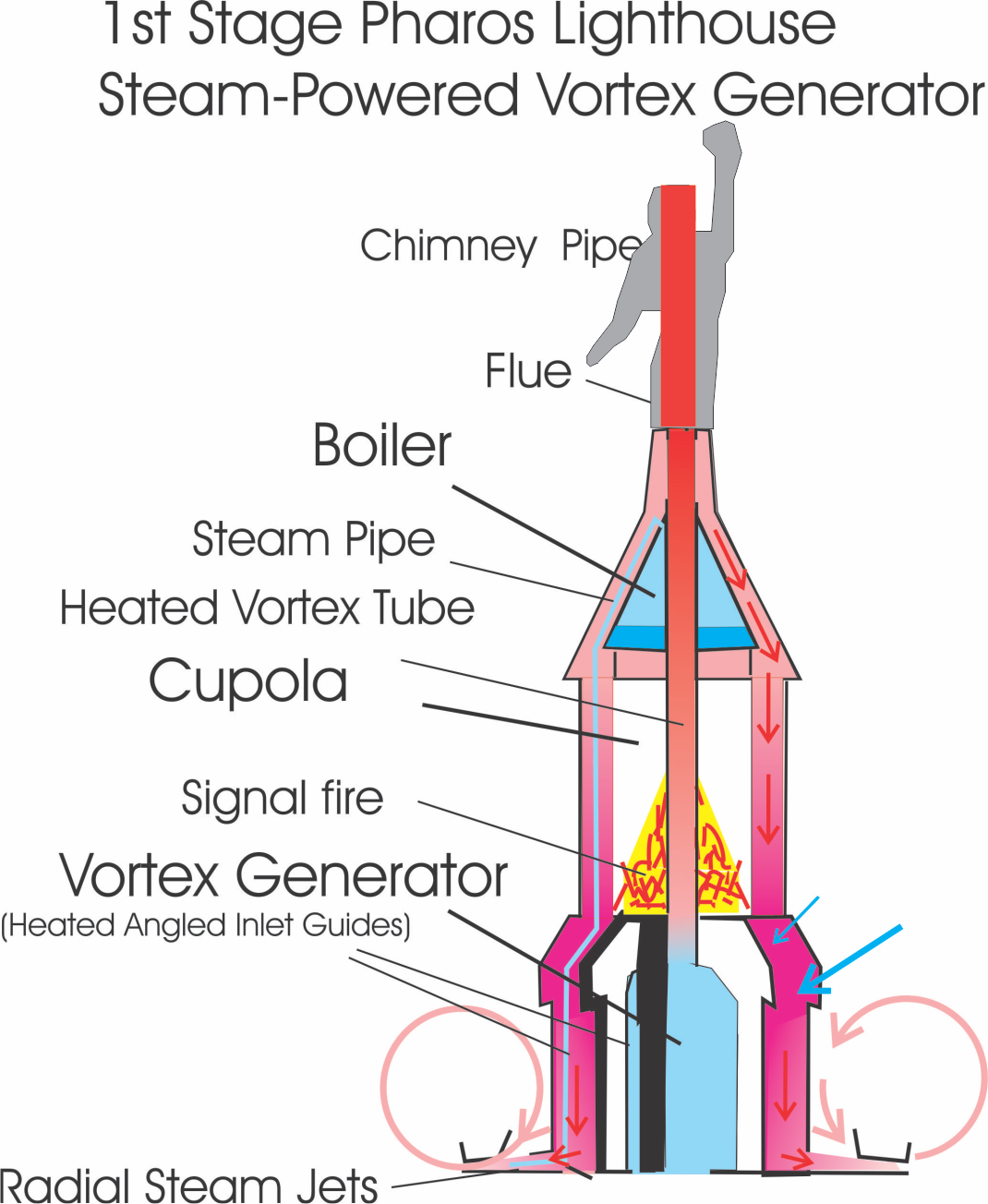
- Whilst the lightfamously served to provide guidance to ships, this, it seems, was purely incidental.
- The fire also heated a central copper flue that went right up through the statue, drawing air from the centre of the vortex generator sited immediately below the beacon fire’s cupola. The flue provided essential suction to the central axis of vortex rotation.
- The rising hot air also passed through a boiler, producing steam.
Piped down to vortex generators, the steam enhanced the air’s humidity and provided impetus to initiate the rotation of two vortexes, the VLV (tornado) inside the tower and the IRV, outside. (Once started, as it grew, the IRV immediately started dropping in 3 stages, down to the plaza before expanding outwards over the sea). - All of the tower below the vortex generator was maintained under suction from the tall (100m) column of cold air inevitably developed within the tower’s hollow stone core.
2nd Stage
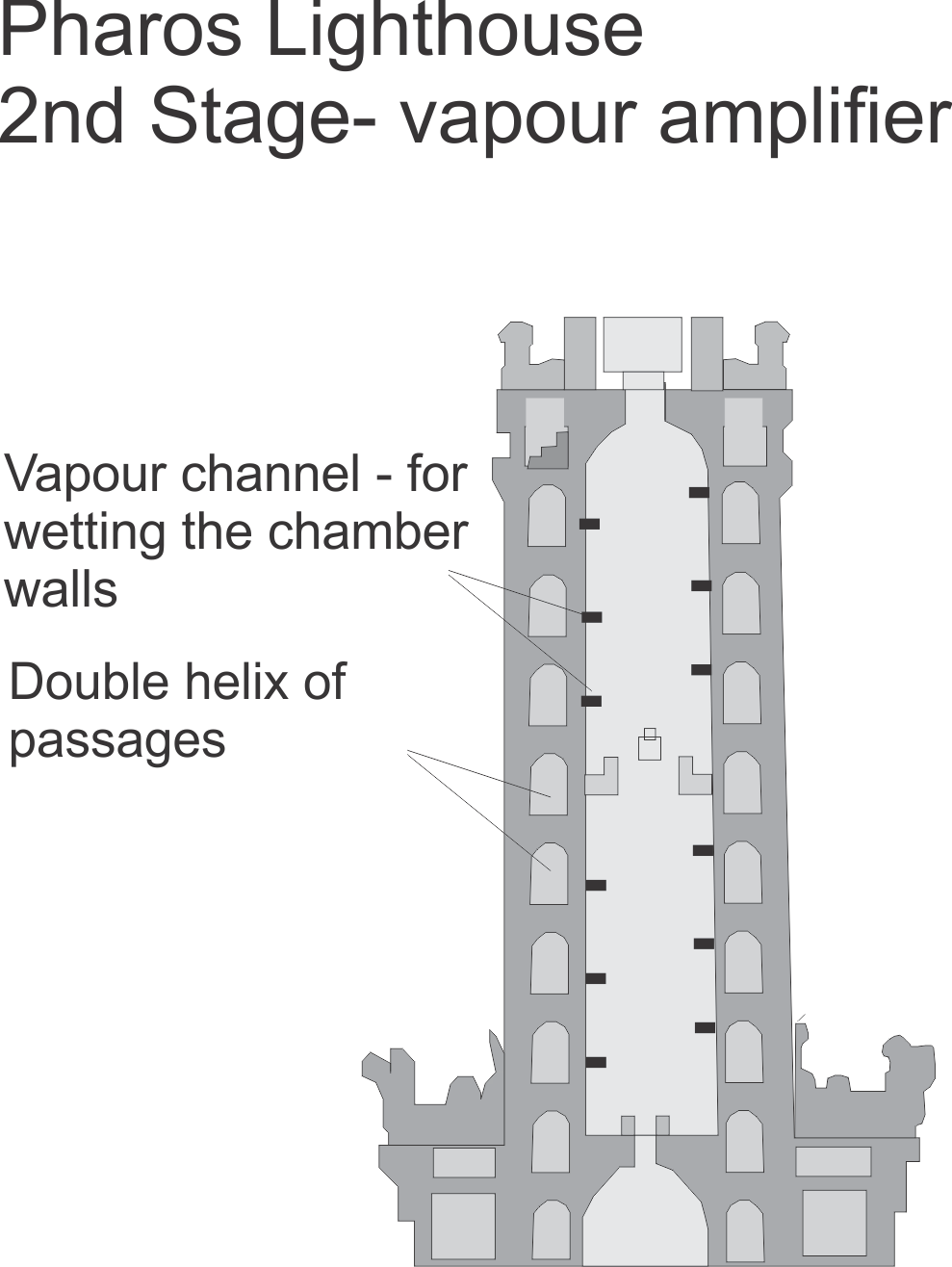
The octagonal ~30m tower section served to enhance and stabilise vapour production. A water channel wound down the outside, keeping the walls wetted with seawater. Sited immediately below the beacon fire’s cupola and vortex generator, the vapour chamber served to enhance and stabilise the supply of vapour-filled air feeding the main vortex tubes below.
Whilst the detailed operation of the 2nd stage is largely speculative, there is a clear distinction between the 2nd and 3rd stages, as provided by the spiral channel around the wall (clearly visible in the original drawings) and by the obvious lack of the storage chambers and double helix of the main tower, surrounding the Stage 3 vortex tubes
Since the primary objective of the whole structure was clearly to produce fresh water, it’s assumed the 2nd stage was used to enhance the air’s vapour content. This conclusion appears born out in tests conducted by the author on his reconstructed working model of the Pharos
3rd Stage and Plaza
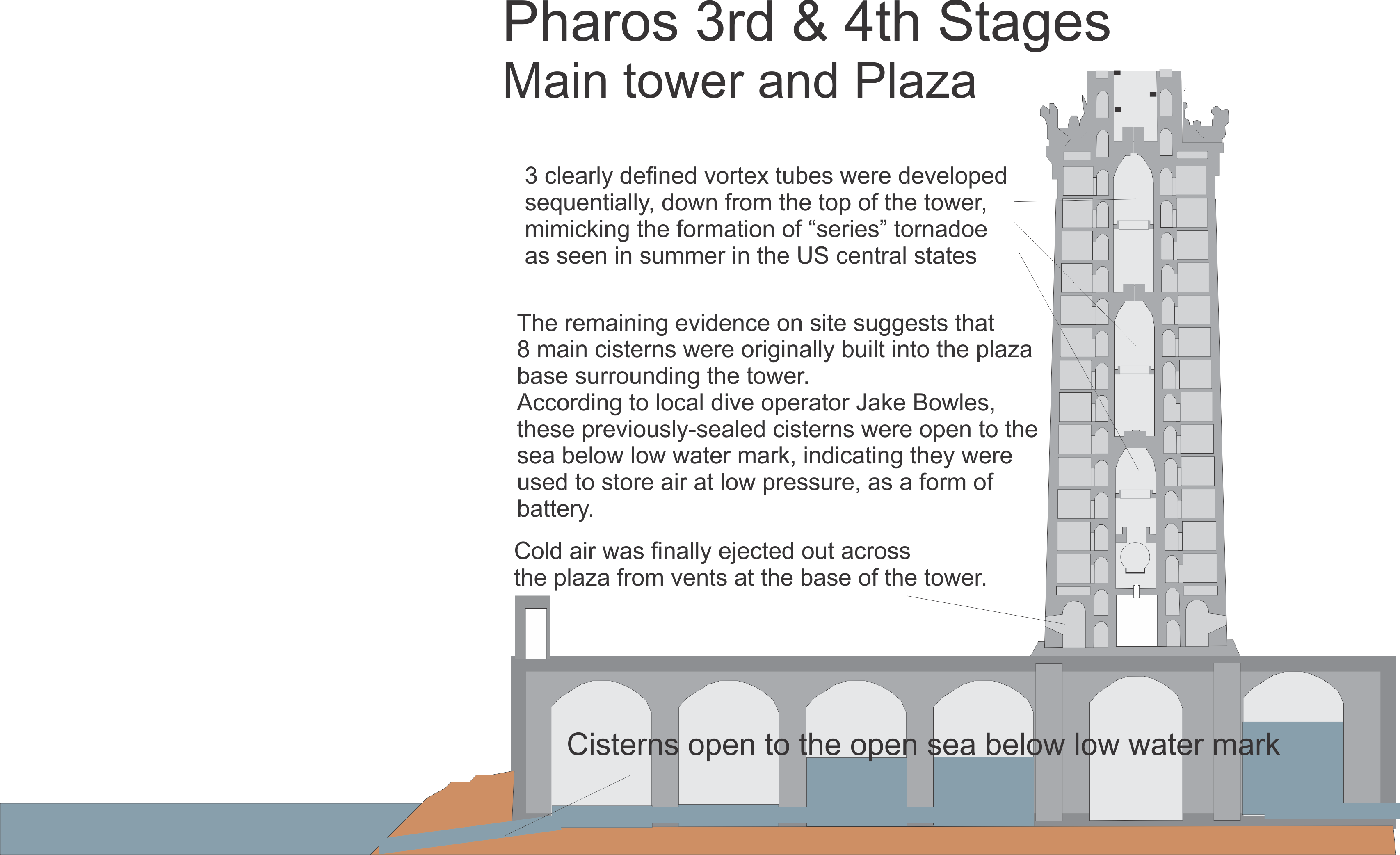
The records tell of a spiral passageway winding its way to the top balcony, but the drawings clearly indicate two spirals, forming a double helix.
The two spirals can be shown as an essential element of a system serving to maximise the available Energy-Differentials in both temperature and pressure, as produced by operating a tornado-type vortex tube.
The Pharos was surrounded by a plaza built over a series of superbly domed cisterns, similar to many others in the city, used for storing fresh water. A number of the original cisterns around the Pharos are still essentially intact but, since they are open below sea level, to tidal influences, they were clearly not used to store fresh water.
One rational conclusion, in line with my theory, is they were essentially used as a form of battery that stored the low pressure produced when the Pharos’ vortex tube was operating.
These are just a few of the many otherwise anomalous details that confirm the true role and purpose of the Pharos as a multi-role building that used atmospheric vortexes in very sophisticated ways.
Practical Development of the ‘MACE’ Phenomena
The republication, in 2002, of WM Flinders Petrie's 1883 seminal work, "The Pyramids and Temples at Gizeh(sic)", was the final confirmation needed, of the extraordinary "laser" precision of the Great Pyramid and its near-certain role in the distant past as a major part of a highly advanced solar-based technology beyond anything yet suspected: just how advanced, I admit I'm still coming to terms with.
After 40 years of somewhat intermittent and erratic advances, the re-emergence of Petrie's book in 2002, inspired me to keep going for another 10 years, until the recovery (c2012) of the data on the Pharos that provided the ultimate confirmation I’d been seeking for so long, along with the extraordinary virtual blueprint of the design of the far more intricate of the two main mechanisms involved in activating and controlling this amazing technology.
The whole MACE technology is essentially based on the two "mirror-image" horizontal Ring vortexes, of the conventional storm cell and the cyclone's "eye". Tornados and other linear vortexes essentially play a support role in a technology which has potential to extract essentially limitless fresh water and sustainable energy, from the open ocean 24/7, all year round. The MACE technology has the potential ability to control and usefully harness all the major elements of our global weather systems from sea level to well over 10,000m.
Suitably controlled, the various elements of the MACE technology have potential to :
- Control or mitigate the power of storms, cyclones and tornados
- Provide rain, virtually anywhere, essentially on demand
- Produce virtually limitless high-grade, usable electrical energy, and
- In two quite separate ways, power the (4) different legendary ‘Vimana-type’ aircraft described in over 10,000 ancient Sanskrit texts.
Mechanical Analysis - the Pharos v Pyramid technology
In stark contrast to the apparent simplicity of the pyramids, the Pharos Lighthouse could scarcely be more complex, with more apparently-anomalous features that can easily be accommodated. On closer investigation, apart from obvious decoration, every one of more than 15 unique features of the Pharos reveals some aspect of an amazing technology. With a basic knowledge of vortexes the potential of the technology is obviousalthough it will undoubtedlt take years to develop it to the sophistication clearly evident in Pharos Great Pyramids.
It's on record that the Pharos operated for 1600 years and underwent at least one and very possibly two major renovations. It clearly produced significant quantities of fresh water and yet was powered by a relatively tiny beacon fire, demonstrating a level of efficiency and sophistication that goes far beyond any known commercial desalination plant of Modern times.